Overview
Strategic Farsight is a website for predicting the future. It’s as easy as typing a question into the input box, but greater complexity lies below the surface for those looking to do more formal studies of the future.
The best place to begin is with the intro video, then head to the site to predict the future!
What follows is more info from the “About” section of the site.
Knowledge Base of the Future
I've wanted this database for decades, specifically as a resource for my overly 'hard' science fiction. But I lacked the stamina to keep up the spreadsheet I started.
Now we have AI. Instead of a lonely soul collecting fragments of research, we have all of the world's information, alive, waiting to have a conversation with us.
There are three ways to use the site: (1) read about the future, (2) ask the AI questions about the future, and (3) build your own hypothetical future scenarios. (See 'Using the Site' below.)
Using the Site
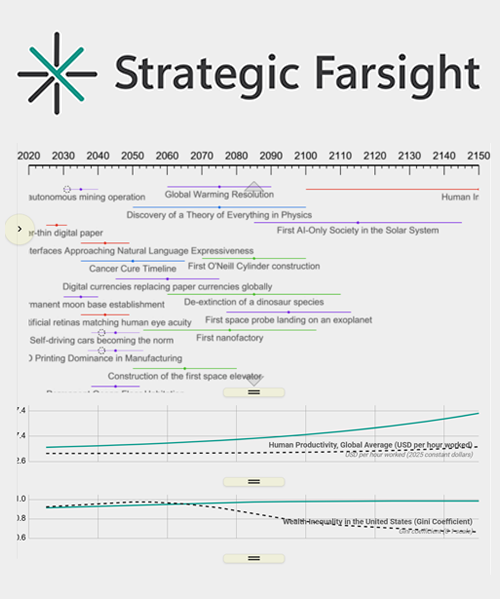
Explore an AI-grounded 'consensus future' by scrolling through the timeline and clicking into the individual predictions and trends. The timeline can be dragged, zoomed, filtered, and sorted. Think of it as an interactive encyclopedia. To access the graphs of specific trends use the search box in the left panel. Treat the site's predictions like any AI-generated material, i.e. as informative but requiring verification. The model produces citations, for instance, under instructions not to invent them, but the results are a mix of exact citations with links, plausible citations with broken links, and on occasion fabricated sources, sometimes from the future (!). So use this site for intellectual stimulation, not print-ready research.
Add to the encyclopedia by asking the AI questions and saving the answers. The system will decline to predict incidental events, like who is going to star in the next James Bond film, but will write short research papers on extrapolatable trends (e.g. population size, biodiversity, etc.) and on four kinds of predictions: discoveries (e.g. in basic science), inventions, products available to the public, and events that can be estimated, like the end of life on earth, or the establishment of the first Mars colony. When the AI produces a sound, well-argued prediction, save it to the timeline. It will then grow the system's knowledge, aiding trend extrapolation and other kinds of analysis. If you do this while logged into the site, your predictions and trends will be saved to your My Stuff library.
Build your own hypothetical future scenarios. Log in to use the Scenario Builder to combine a question/prompt with a context, from which the AI can generate analysis reports. The prompt might be 'Describe the landscape for telco providers in the Africa of the 2030s' and the context 'Assume commercial space advances proceed 20% faster than expected.' The AI will use the context to adjust the dates of baseline predictions, as well as the trend graphs, then it will write an analytical report framed by the hypothetical future. Accompanying the report will be revised views of the timeline and of the trends graphs as compared to the baseline. These reports can be saved to a private library or published to the community. Note that analysis reports cost 'credits,' due to the cost of the AI services, but all users get 3 free reports for testing the output. To access the Scenario Builder, press the yellow button under the search box on the home screen.